Lanzhou University Holds Pre-launch Event for New Book *Natural Muon Technology and Its Applications*, Filling a Gap in the Domestic Knowledge Base in this Field
On 3 July, at the ‘Forum on Fostering and Developing Future Industrial Scenarios through Green Nuclear Technology’, jointly organised by Lanzhou University, the Gansu Economic Research Institute, the Gansu Nuclear Industry Research Institute and other organisations, a pre-launch ceremony was held for *Natural Muon Technology and Its Applications* (Volumes I and II).It is understood that the book is due to be published shortly by Science Press. As the first academic monograph in China to systematically expound on the fundamental theories and engineering applications of natural muon technology, it fills a gap in the body of knowledge in this field.
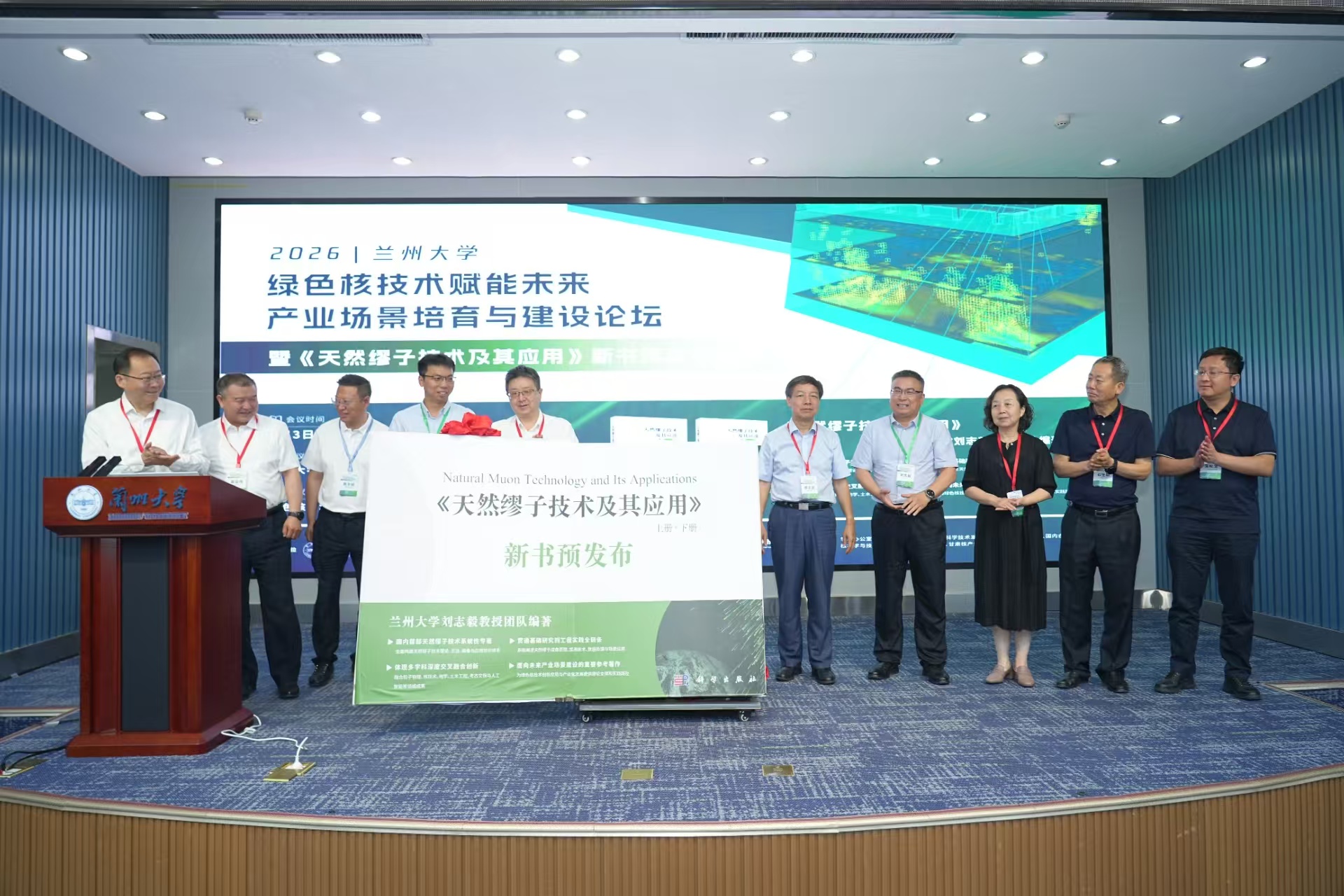
This forum focused on cutting-edge topics such as the industrialisation of green nuclear technology, the cultivation of future industrial applications, and the development of capabilities for detecting complex concealed structures. Over a hundred guests—including representatives from relevant government authorities, experts and academics in related fields, representatives of end-users, upstream industrial enterprises, and investment and financing institutions—attended the event to engage in in-depth discussions on pathways for technology transfer and opportunities for industrial collaboration, making it a high-profile industry-academia-research networking event in the field of natural muon technology in China.
At the main forum held that morning, Pu Songtao, Director of the Future Industries Research Centre at the CCID Research Institute of the Ministry of Industry and Information Technology, delivered a keynote speech entitled ‘Proactive Planning and Fostering the Development of Future Industries’. The speech systematically examined the defining characteristics and global competitive landscape of future industries, noting that these sectors—driven by breakthroughs in cutting-edge technologies and guided by cross-sectoral integration—are currently in a critical window of opportunity for technological incubation and the development of practical applications; In line with the direction of China’s 15th Five-Year Plan, the report focused on analysing development opportunities within specific sectors, emphasising the need to leverage the strengths of universities in original innovation and regional resources for practical applications to accelerate the transition of cutting-edge technologies from the ‘laboratory’ to deep practical application. It provided a macro-policy perspective and strategic guidance for the industrialisation of green nuclear technology.
A team led by Professor Liu Zhiyi from the Centre for Frontier Science of Rare Isotopes at Lanzhou University delivered a keynote presentation, systematically showcasing the team’s latest breakthroughs in the development, engineering validation and multi-scenario applications of natural muon detection systems. They also presented data results from real-world scenarios such as mineral exploration, underground railway tunnels, earth-and-rock dams, the Yungang Grottoes and the Maijishan Grottoes, attracting considerable attention from participating enterprises and investment institutions.
During the afternoon’s parallel sessions, in-depth discussions centred on ‘fostering future industrial scenarios’ and ‘developing capabilities for sensing complex and concealed structures’. Several organisations reached agreements on cooperation on the spot, effectively pressing the ‘fast-forward button’ on the transition of these technologies from research to large-scale application.
As a key part of the forum, a pre-launch ceremony was held for *Natural Muon Technology and Its Applications* (Volumes I and II). It is reported that the book was compiled by Liu Zhiyi’s team. As the first academic monograph in China to systematically expound on the fundamental theories and engineering applications of natural muon technology, it elevates fragmented engineering practices to a systematic body of knowledge, providing a robust knowledge framework and support for talent development to foster a new form of productive forces.
Against the current strategic backdrop of Gansu Province accelerating the roll-out of scenario-driven innovation and vigorously promoting the development of future industries, the holding of this forum marks a milestone that builds on past achievements and paves the way for the future. As the first forum on scenario cultivation and development—led by a university and focusing on a single cutting-edge technology—to be held since the introduction of the provincial implementation plan for scenario cultivation, it not only represents a proactive response to the top-level design but also constitutes a crucial step in moving ‘scenario cultivation’ from a policy blueprint into the implementation phase.
The forum has established a scenario-based innovation ecosystem centred on higher education institutions and involving collaboration amongst government, industry, academia, research organisations and investors. Breaking away from the traditional model of one-way dissemination of research outcomes, it brings together scenario stakeholders, upstream and downstream enterprises, and investment and financing institutions to forge a two-way pathway from the laboratory to the market, thereby providing a replicable model for helping cutting-edge technologies bridge the ‘Valley of Death’.
From a broader perspective, this forum also represents a vivid example of Lanzhou University’s proactive integration into national strategies and its commitment to serving the high-quality development of the western regions. The in-depth application of natural muon technology in areas such as resource security, engineering safety and the protection of cultural heritage aligns precisely with the inherent strengths and practical needs of the western regions, demonstrating the vast potential for basic disciplines to move from the ‘bookshelf’ to the ‘shelf’.

 Gansu PSB Record No.62010202000830
Copyright ©2025 Muon Exploration Laboratory. All Rights Reserved.
